Most Software Agencies Are Selling Projects the Wrong Way
 Adrian Guerra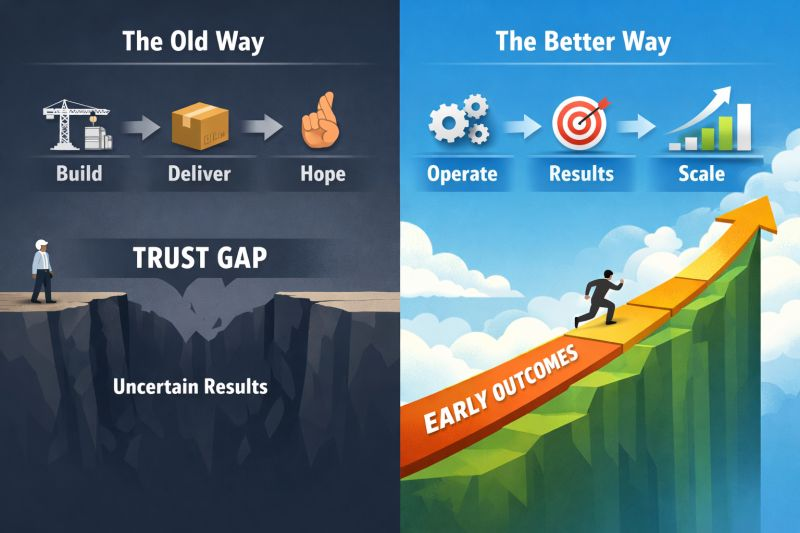
Most software agencies struggle with long sales cycles, hesitant buyers, and deals that stall right before the finish line.
Not because their technology is bad.
Not because they lack skill.
But because their offer structure is broken.
The Common Agency Sales Pattern
Here's the pattern I see over and over again:
- •The agency sells a large custom build
- •The real outcome only happens after delivery
- •Intellectual property is transferred to the client
- •Both sides hope it works
From the agency's perspective, this feels normal.
From the client's perspective, it feels risky.
What the client really hears is:
“We're going to invest time and money now… and hopefully see results later.”
That gap between investment and outcome is the real problem.
The Real Issue Isn't Quality. It's Timing.
Most agencies assume the issue is trust.
So they try to fix it with guarantees, discounts, or more documentation.
But the real issue isn't trust.
It's outcome timing.
Clients don't want:
- •to own another piece of software
- •a “capital asset” they now have to manage
- •custom IP they're responsible for maintaining
What they actually want is simple:
- •revenue
- •momentum
- •booked meetings
- •proof that something is working
And they want it as early as possible.
Why Custom Builds Create Friction
When you sell a custom project where ownership transfers immediately, you create several problems at once:
- •Results are delayed until delivery
- •The client carries all the operational risk
- •Every project becomes a one-off
- •Learning resets with each new engagement
Even if the build is excellent, the structure works against you.
A Better Model: Change Ownership and Risk
The fastest way to close the trust gap isn't offering more guarantees.
It's changing who owns and operates the system while results are being generated.
When agencies:
- •keep the IP
- •operate the system themselves
- •carry delivery and performance risk
Several things happen immediately:
- •Outcomes can start much earlier
- •The offer becomes outcome-first, not feature-first
- •Learning compounds across clients
- •Delivery becomes repeatable instead of bespoke
The agency stops selling “a build” and starts selling performance.
Keeping the IP Often Increases Client Value
This is the part many agencies get wrong.
Keeping the IP doesn't reduce client value.
In most cases, it actually makes value show up faster.
Clients don't need ownership on day one.
They need results.
If ownership ever truly matters, that conversation can happen after performance is proven, not before.
The Question Every Agency Should Ask
If you're a software agency dealing with long sales cycles, stalled deals, or skeptical buyers, ask yourself this:
Are you selling software…
or are you selling outcomes in the slowest possible way?
That distinction changes everything.